AgriTech Software: How AI Is Modernizing Livestock Management
Livestock farming has always depended on accurate records, timely decisions, and close observation of animal health. As herds grow and regulatory requirements get more demanding, paper records and disconnected spreadsheets stop keeping up. Information is scattered, health issues get missed, and the time spent on administration keeps growing.
Digital platforms are changing how this works. Modern livestock management software lets producers collect operational data, monitor animals in real time, automate routine processes, and get a clearer picture of what’s actually happening on the farm. The technology doesn’t replace the experience of veterinarians and farm managers – it gives them better information to work with.
Core Capabilities of Modern Livestock Management Software
Most livestock management platforms cover a common core:
- animal identification and tracking,
- health and treatment records,
- breeding and reproduction management,
- feed planning and consumption monitoring,
- weight and growth tracking,
- vaccination scheduling,
- inventory management,
- regulatory reporting,
- performance analytics.
Having these in one system matters in practice. If an animal’s weight gain slows unexpectedly, a manager can check feeding history, veterinary records, environmental conditions, and past performance without opening multiple systems. That kind of quick cross-referencing is hard to do with fragmented records.
Real-time monitoring and early detection
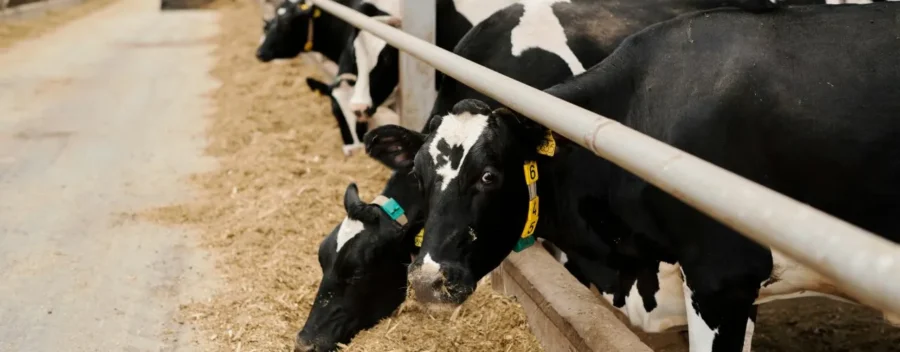
One of the more significant developments in precision livestock farming is continuous animal monitoring through connected sensors and wearable. Body temperature, activity levels, heart rate, rumination patterns, feed intake, location – these can all be tracked without someone physically checking each animal.
Instead of waiting for visible signs of illness, staff get alerts when behavior shifts outside expected patterns. Early detection gives veterinarians and managers time to investigate before a problem becomes serious. It improves animal welfare and tends to reduce treatment costs and production losses.
Agiliway is an AI-Augmented Software Development company that helps AgriTech businesses build intelligent livestock management platforms with IoT integration, real-time monitoring, cloud infrastructure, and AI-driven analytics to improve operational visibility and decision-making across modern farming operations.
AI and analytics
Artificial intelligence is becoming an increasingly valuable component of AgriTech software. Rather than replacing farm managers, AI analyzes large volumes of operational data to identify patterns that may otherwise go unnoticed.
Examples include:
- Predicting disease risks based on behavioral changes
- Identifying breeding opportunities
- Forecasting feed requirements
- Detecting production anomalies
- Estimating growth performance
- Optimizing resource allocation.
The value is in spotting patterns across large volumes of data that a person would be unlikely to catch manually. These outputs are decision-support tools, not automated instructions. Final calls still depend on veterinary expertise and what’s happening on the ground.
Integration with existing systems
Farms don’t run on animal management software alone. Accounting platforms, inventory systems, feed management tools, veterinary applications, IoT devices – most operations have several. AgriTech platforms designed to integrate with these through APIs and cloud services can move information between systems automatically.
Feed deliveries update inventory records. Veterinary treatments appear in animal health histories. Sensor data feeds directly into monitoring dashboards. Production metrics populate management reports. Less manual data entry means fewer errors and a more complete picture of what’s happening.
Key considerations before implementing AgriTech software
Comparing feature lists is the easy part. The questions that actually determine whether a platform works for a specific operation tend to be more practical.
Scalability
The platform should handle future herd growth, additional locations, and changing requirements without needing to be rebuilt. Most farms evaluate software based on current needs, which is reasonable, but the ones that switch platforms two years in almost always say scalability was something they didn’t check carefully enough.
Ease of Use
This is the question that determines whether everything else matters. Farm managers, veterinarians, and field workers use the system under time pressure, outdoors, often with dirty hands. If the interface isn’t straightforward, usage becomes inconsistent. Inconsistent usage produces worse records than no system at all, because it creates the illusion of complete data while actually missing gaps. Simple interfaces drive adoption more than extensive feature sets, almost every time.
Mobile Accessibility
Most livestock work doesn’t happen in an office. If staff can’t update records, review animal histories, and receive alerts from the field, the practical result is double entry, notes recorded somewhere else and entered into the system later. That’s how data gaps happen, and it’s exactly the problem these platforms are supposed to solve.
Integration Capabilities
Farms run on multiple systems – feed management, accounting, veterinary software, IoT devices. A platform that doesn’t integrate with these creates duplicate work and data that lives in different places and doesn’t match. Good integration isn’t optional; it’s what determines whether the platform fits into how the operation actually runs.
Data Security
Operational records, production data, and financial information are valuable and increasingly held in third-party systems. Before committing, it’s worth getting specific answers on user access controls, backup procedures, cloud security practices, audit logs, and how the vendor handles regulatory compliance. These questions become more important, not less, as the farm adds connected devices and more of its operations depend on data being accurate and accessible.
Conclusion
Livestock management software is moving beyond record-keeping. Better AI, more IoT connectivity, computer vision, and predictive analytics are enabling more proactive management – forecasting health risks, optimizing feeding, supporting breeding decisions, coordinating workflows across whole farming enterprises.
Experienced farm managers and veterinarians remain central to all of it. The platforms provide better information faster. The expertise to act on it still comes from people who know the animals and the operation.
Building these platforms well requires understanding both the technology and how farms actually work. Agiliway has experience helping AgriTech companies with this kind of development, combining IoT integration, cloud infrastructure, and AI analytics with practical knowledge of farming operations.
If you’re planning to build or improve a livestock management platform, reach out to Agiliway to discuss your project.