
 EN
EN  UA
UA 
AI Agents vs. Traditional Automation: What’s really changing in 2026
Traditional automation follows scripts. AI agents make decisions. That fundamental difference is reshaping enterprise technology in 2026. If you think automation has already peaked, this year will challenge everything you thought you knew.
Let’s take a look at the key differences between agentic AI and traditional automation and what they mean for your organization in 2026.
What Traditional Automation Still Does Best
Before comparing AI agents with traditional automation, it’s important to define what these concepts are. So, traditional automation refers to the use of predefined scripts, rule-based processes, and IT-driven workflows designed to execute repetitive, structured tasks without human intervention. They typically require extensive coding and integration into existing enterprise infrastructure, relying heavily on structured data and fixed sequences to operate effectively.
The main benefits of such an approach include high efficiency, consistency, reliability, and lower upfront costs. Considering them, traditional automation is especially suitable for industries or departments with stable, routine processes.
However, traditional automation also faces distinct limitations. It is inherently rigid. Therefore, any changes in business rules, processes, or data structures demand manual reprogramming and substantial IT effort. Lack of flexibility means these systems struggle to adapt when workflows evolve or when faced with ambiguous or unstructured inputs. Furthermore, traditional automation lacks the ability to learn, improve, or make decisions beyond its programmed logic, meaning it cannot evolve its behavior based on new data or changing scenarios.
The Era of Intelligent Agents
Now, let’s figure out what AI agents are. They are autonomous software entities designed to perceive their environment, reason about context, make decisions, and take actions with minimal to no human intervention. Unlike traditional automation, which executes fixed rule-based workflows, AI agents employ advanced cognitive tools such as large language models, machine learning algorithms, and natural language processing to learn from experiences and adapt behavior in real time.
These agents can dynamically interact with multiple enterprise systems, analyze vast amounts of structured and unstructured data, and orchestrate complex end-to-end workflows. A single AI agent might autonomously resolve customer issues by querying a CRM, processing transactions, and interfacing with third-party logistics or support channels. The ability to continuously improve and self-optimize distinguishes AI agents. They can handle ambiguity, evolve with changing organizational needs, and independently manage exceptions or unforeseen conditions.
Key features that set AI agents apart include their adaptability, goal-driven orientation, contextual intelligence, the ability to perceive nuances beyond preset instructions, and the ability to refine their responses through feedback loops, scaling their capabilities in complex environments without requiring major human intervention or programming updates.
Choosing the Best Path in 2026
The shift from traditional automation to Agentic AI revolves around three key pillars: autonomy, adaptability, and decision-making. Other differences can be seen in the table below:
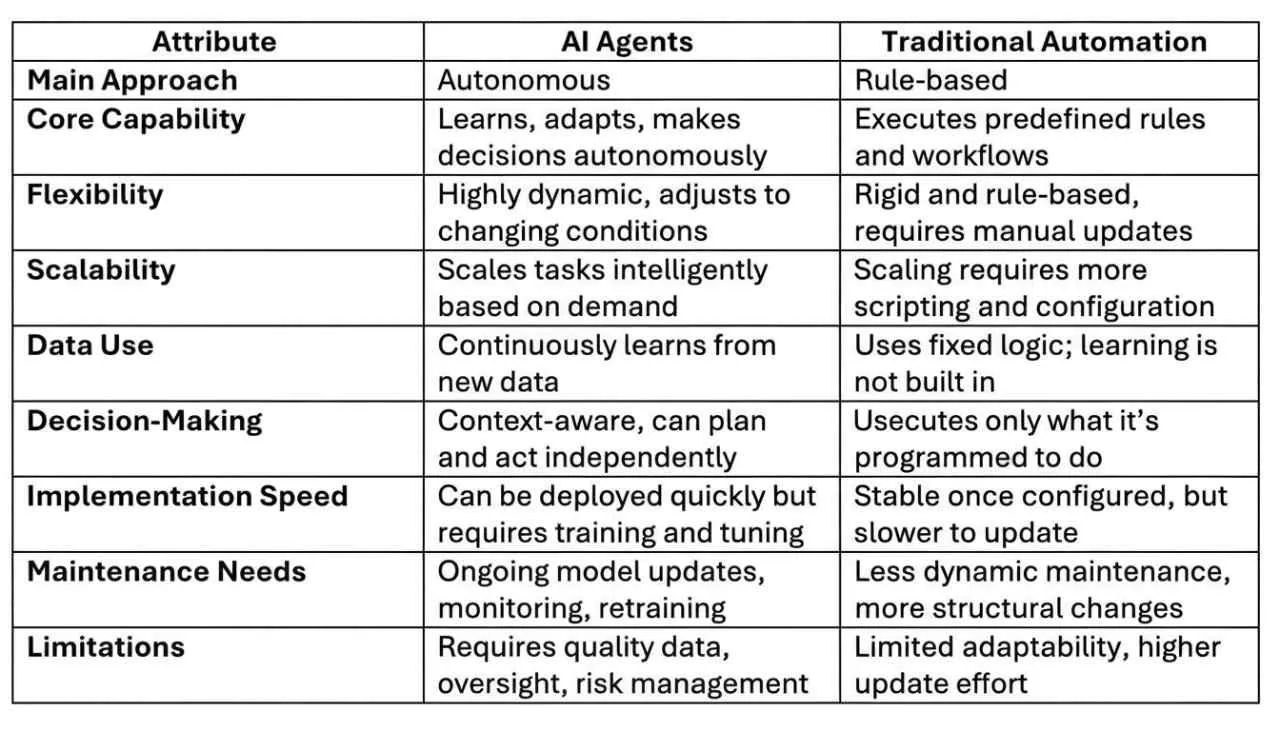
When it comes to choosing between AI agents and traditional automation, consider the following. Think of your project. If it’s dynamic and fast-changing, then agentic AI offers better long-term ROI by reducing maintenance work and speeding up release cycles.
If your project is stable and predictable, you have a consistent UI and a skilled development team, traditional frameworks still deliver strong control and reliable performance.
And do not forget about the hybrid path. Many teams benefit from combining both approaches. Traditional tools for stable, performance-driven API testing and Agentic AI for complex, fast-changing end-to-end UI scenarios.
Wrapping It Up: Key Takeaways on AI Agents and Traditional Automation
Traditional QA tools set the stage for automation, but the next wave is smarter. The future lies in a more intelligent approach – Agentic AI. Key factors driving this transformation include maturing agentic frameworks that streamline orchestration, governance, and real-time adaptability. Companies are rethinking automation scripts and pivoting to agentic systems that continuously learn, collaborate, and optimize for business outcomes.
The adoption curve of AI agents is steep. Gartner projects that 40% of enterprise applications will feature task-specific AI agents by the end of the year, while surveys show over 66% of enterprises already recognize productivity and cost-saving benefits from agentic automation.
If you are interested in learning more or want to adopt the Agentic AI, contact us to arrange a call with our experts and discuss any additional inquiries!