
 EN
EN  UA
UA 
SQL and Database Management: The Foundation of Modern Data Systems
In a world of AI, real-time analytics, and cloud-native apps, data moves faster than ever. But speed without structure is chaos. SQL and database management provide the order behind the scenes. Organizing massive volumes of information so systems can scale, insights can be generated instantly, and users can interact with technology seamlessly.
Exploring SQL: Structured Query Language
SQL, standardized by ANSI in 1986 and ISO thereafter, organizes data into tables with rows and columns linked by keys. It remained remarkably relevant despite massive changes in technology. SQL organizes data into tables made up of rows and columns. Tables are linked through keys: primary keys uniquely identify records, while foreign keys define relationships between tables. At its core, SQL supports four major categories of operations:
- Data Definition Language (DDL) – DDL commands define and manage database structures. Statements such as CREATE, ALTER, and DROP are used to create tables, modify schemas, or remove database objects entirely.
- Data Manipulation Language (DML) – DML focuses on working with the data itself. Commands like SELECT, INSERT, UPDATE, and DELETE allow users and applications to retrieve, add, modify, and remove records.
- Data Control Language (DCL) – Security and access control are handled through DCL. Commands such as GRANT and REVOKE determine who can read, write, or modify data.
- Transaction Control Language (TCL) –TCL ensures consistency and reliability through commands like COMMIT and ROLLBACK. Transactions allow multiple operations to be treated as a single logical unit, following the ACID properties (Atomicity, Consistency, Isolation, Durability).
DBSM: Understanding Database Management Systems
A DBMS (Database Management System) is the software layer that manages databases and provides controlled access to data. Popular examples include MySQL, PostgreSQL, Oracle Database, SQL Server, and SQLite.
Key responsibilities of a DBMS include:
- Data storage and retrieval with optimized performance
- Concurrency control allows multiple users to access data simultaneously
- Transaction management to add consistency and reliability
- Security and access control
- Backup and recovery to protect against data loss
There are also many types of database management systems available. The main categories include Relational DBMS, Hierarchical DBMS, Network DBMS, Object-Oriented DBMS, NoSQL DBMS, Columnar DBMS, and In-Memory DBMS.
Relational DBMS (RDBMS)
Relational database management systems organize data into tables made up of rows and columns, with predefined relationships between tables enforced through keys and constraints. They use SQL for querying and managing data and are known for strong consistency and reliability.
Examples: MySQL, PostgreSQL, Oracle Database, Microsoft SQL Server.
NoSQL DBMS
NoSQL databases are designed for flexible schemas, large-scale data, and distributed architectures. They are well-suited for semi-structured or rapidly changing data models and high-performance applications. NoSQL systems include several subtypes:
- Document stores: MongoDB, Couchbase
- Wide-column stores: Apache Cassandra, HBase
- Key-value stores: Redis, DynamoDB
- Graph databases: Neo4j
Object-Oriented DBMS (OODBMS)
Object-oriented DBMS stores data as objects, similar to object-oriented programming languages. These objects contain both data (attributes) and behavior (methods), and they support concepts like inheritance and encapsulation.
Examples: ObjectDB, db4o, GemStone/S.
Hierarchical DBMS
Hierarchical databases organize data in a tree-like structure, where each record has a single parent and possibly many children. This model is efficient for representing one-to-many relationships but is less flexible for complex data connections.
Example: IBM Information Management System (IMS).
Network DBMS
Network databases extend the hierarchical model by allowing records to have multiple parent and child relationships, forming a graph structure.
Example: Integrated Data Store (IDS), IDMS.
Columnar DBMS
Columnar databases store data by columns instead of rows, which makes them highly efficient for analytical queries that process large volumes of data across specific fields.They are widely used in data warehousing and business intelligence.
Examples: Amazon Redshift, Google BigQuery, ClickHouse.
In-Memory DBMS
These databases primarily store data in RAM instead of disk, enabling extremely fast read and write operations. In-Memory DBMS are often used in real-time applications such as caching, analytics, and high-frequency transactions.
Examples: SAP HANA, Redis, SingleStore (MemSQL).
SQL vs. DBSM
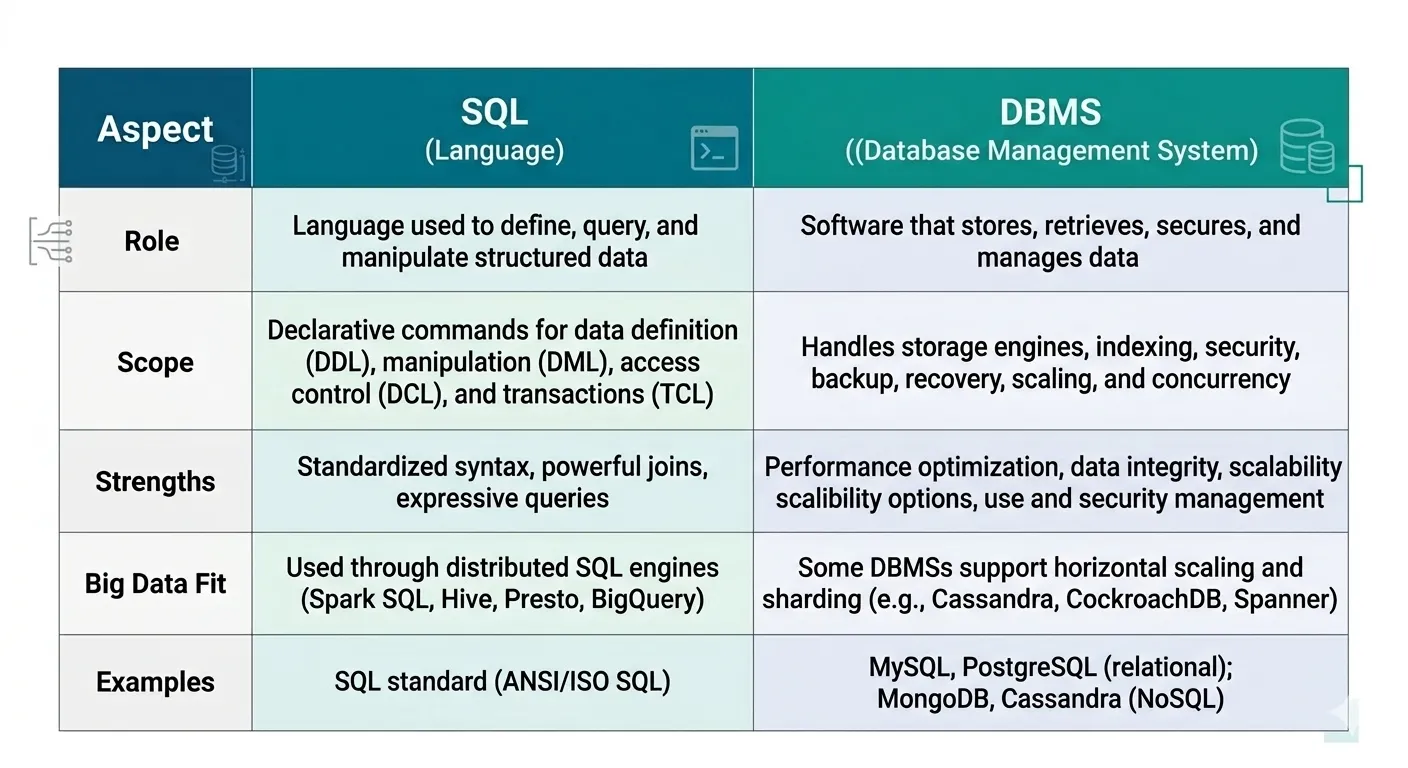
SQL and DBMS are often mentioned together, but they are not the same thing. SQL is a language – a standardized way to define, manipulate, and control data. A DBMS is the system that understands SQL and executes those commands efficiently.
SQL in the Era of Big Data and NoSQL
The Rise of NoSQL and Alternative Approaches
As web applications exploded and data volumes skyrocketed, some cracks appeared in the relational model. NoSQL databases emerged to handle these new challenges. Different types tackled different problems. Document databases like MongoDB store flexible JSON-like records, ideal for applications where data structure varies. Key-value stores like Redis offer blazing speed for caching and session management. Graph databases like Neo4j excel at mapping complex relationships, think social networks or recommendation engines. Column-family databases like Cassandra handle massive scale across distributed systems. However, NoSQL databases often sacrifice some ACID guarantees for speed and flexibility.
Modern Database Landscape: SQL and NoSQL Together
With the rise of big data, distributed systems, and NoSQL databases, SQL was once predicted to fade into obscurity. Instead, it evolved. Modern data platforms often combine both worlds. Cloud data warehouses like Snowflake, BigQuery, and Redshift use SQL as their primary interface while scaling across distributed infrastructure. Even many NoSQL systems now offer SQL-like query layers because of SQL’s familiarity and expressive power.
In analytics, SQL acts as a universal language. Data engineers use it to transform raw data, analysts rely on it for insights, and machine learning pipelines often start with SQL-based feature extraction.
Final Word
Despite rapid advances in AI, SQL, and database management remain central to modern technology. SQL is still the primary way we query data, whether from traditional databases, cloud warehouses, or modern analytics platforms. Understanding how databases work, how to query them effectively, and how to manage them properly isn’t optional for anyone serious about working with data.
Feel free to contact us to discuss any additional questions you might have. Our experts are there to help you.