

Behavior Deviation Detection in Video Surveillance: How It Works in Practice
How do you teach a camera to recognize that something is “off” when nothing illegal has happened yet? Abnormal behavior rarely looks dramatic. It looks ordinary until you compare it to everything else. That’s the power behind behavior deviation detection in video surveillance.
This article examines how behavior deviation detection functions in production video surveillance environments. We’ll cover the technical mechanisms, implementation approaches, common use cases, and the practical challenges organizations face when deploying these systems.
What Is Behavior Deviation Detection?
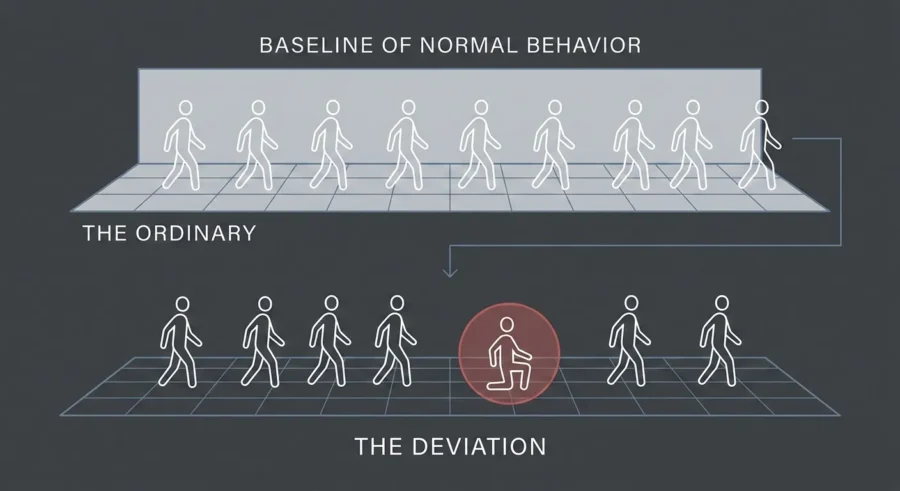
Detecting and preventing deviant behavior is an important and timely task in modern intelligent surveillance systems. Behavior deviation detection identifies activities or patterns that differ from established norms within a monitored environment. The system learns what “normal” looks like, for example, people walking through a lobby, cars moving through a parking lot, equipment operating in a facility, and flags events that fall outside these learned patterns.
The distinction between deviation detection and simple motion detection matters. Motion detection triggers on any movement within a frame. Deviation detection analyzes whether that movement fits expected patterns for that location and time. So, a person entering a restricted area at 3 PM might be normal. The same action at 3 AM warrants investigation.
How Behavior Deviation Detection Works
At its core, behavior deviation detection systems analyze video feeds to spot actions that differ from established patterns of normal behavior. The process typically follows these stages:
- Video Capture: Surveillance cameras continuously record footage, either for real-time monitoring or later analysis.
- Object Detection and Tracking: AI models detect and track moving objects, primarily people and vehicles, within the scene. Modern systems often use deep learning-based object detectors such as YOLO (You Only Look Once) or Faster R-CNN for this task.
- Feature Extraction: The system extracts key features from the detected objects, such as motion patterns, speed, trajectory, size, and shape. These features are crucial for understanding the context of the behavior.
- Behavior Modeling: The system builds a model of “normal” behavior by analyzing historical data or predefined rules. This baseline is used as a reference for detecting deviations.
- Anomaly Detection: Real-time data is compared to the normal behavior model. If a significant deviation is detected, such as a person running in a restricted area or loitering for an unusual amount of time, the system flags it for further review or triggers an alert.
Multi-Level Analysis of Human Behavior in Video Surveillance
Modern behavior deviation detection systems rely on multi-level analysis. At the lowest semantic level, raw video data is transformed into structured descriptions of a person’s physical attributes and actions. This includes body posture, hand positions, facial expressions, gaze direction, and movement dynamics.
These low-level descriptors are then passed to higher-level classifiers that analyze behavior patterns rather than isolated features. Layered architecture allows the system to reason about intent and social risk, not just motion. By separating feature extraction from behavioral interpretation, surveillance systems gain greater flexibility and robustness in complex real-world settings.
Key Techniques and Algorithms
Several advanced techniques are employed to improve the accuracy and efficiency of behavior deviation detection:
- Rule-Based Detection: This approach uses pre-set rules to identify abnormal behavior. For example, running in a shopping mall or entering a restricted area can trigger an alert.
- Statistical Modeling: Statistical models are trained on historical video data to establish what typical behavior looks like. Any data point that deviates significantly from this baseline is flagged as abnormal.
- Deep Learning Models: Convolutional Neural Networks (CNNs) and Long Short-Term Memory (LSTM) networks are widely used for video-based anomaly detection due to their ability to capture spatial and temporal patterns. CNNs excel at recognizing local features, while LSTMs are effective for modeling sequential data, such as human movement over time.
- Skeleton-Based Methods: Some systems use pose estimation algorithms like OpenPose to extract 2D or 3D skeleton data from human figures. This data is then analyzed to detect abnormal movements or postures.
- Privacy-Preserving Techniques: To address privacy concerns, some systems use synthetic video data or mask sensitive regions before analysis. This allows for anomaly detection without exposing identifiable information.
Common Applications and Use Cases in Behavior Deviation Detection
Behavior deviation detection has moved from experimental research into practical deployment across a wide range of domains. Its main value lies in the ability to identify risky or socially dangerous situations early, even when behavior appears normal at first glance. By analyzing movement patterns, body language, and contextual cues, such systems support proactive decision-making rather than reactive response.
In public safety, behavior deviation detection is most often applied in crowded environments such as airports, metro stations, stadiums, shopping malls, and city centers. Traditional surveillance can identify obvious incidents like fights or vandalism, but intelligent systems go further by detecting early warning signs. These may include an attempt to commit an offence, unusual interest in restricted zones, abandoned objects, or subtle stress indicators visible in posture and facial expressions.
In traffic management, behavior deviation detection contributes to safer and more efficient transportation systems. Surveillance cameras combined with intelligent analysis can detect abnormal vehicle behavior, such as sudden stops, illegal lane changes, driving against traffic, or unexpected pedestrian presence on roadways. Deviations often signal accidents, vehicle breakdowns, or hazardous driving conditions.
Healthcare monitoring is another important application area, especially in hospitals, assisted living facilities, and private homes for elderly or vulnerable individuals. Here, behavior deviation detection focuses on identifying emergencies rather than security threats. Systems can recognize falls, prolonged inactivity, unusual movement patterns, or signs of distress. Since many incidents occur when no caregivers are present, automated detection plays a crucial role in ensuring timely assistance.
In workplace security and industrial environments, behavior deviation detection is used to ensure safety compliance and protect sensitive areas. Surveillance systems can identify unauthorized access to restricted zones, unsafe behavior near heavy machinery, or violations of safety protocols such as missing protective equipment. In high-risk industries, even small deviations from established procedures can lead to serious accidents.
Data Privacy and Compliance Considerations
Behavior deviation detection raises privacy concerns. Many regulations, like European GDPR regulations, California’s CCPA, and various industry-specific requirements, impose restrictions on video analytics and data retention. Anonymization techniques help address privacy requirements. Some systems analyze behavioral patterns without identifying specific individuals, tracking movement and activities while obscuring facial features. Others process video locally and transmit only metadata and alerts rather than storing full video footage.
Besides this, anomalous events are diverse and often unpredictable, crowded scenes can affect detection accuracy, or the system may flag normal behavior as abnormal, leading to unnecessary alerts.
Conclusion
Behavior deviation detection represents a critical evolution in video surveillance. Modern systems can identify threats that are subtle, latent, and intentionally concealed. Through multi-level behavior analysis, learning-based classification, and the integration of non-verbal cues, these systems move surveillance from reactive recording to proactive prevention.
While technical, ethical, and privacy challenges remain, behavior deviation detection offers a practical path toward more intelligent and effective public safety systems. When combined with human expertise, it has the potential to significantly improve early threat detection in complex, real-world environments.